

Safety as Strategy: Why Competent Health and Safety Consulting is Essential for SME Success

For small to medium enterprises (SMEs), navigating the complex landscape of legal compliance and operational risk can feel like a heavy burden. Many business leaders view health and safety (H&S) as a necessary cost or a bureaucratic hurdle, but this perspective overlooks a crucial truth: competent H&S advice is not merely about ticking boxes; it is a foundational pillar of operational success, long-term sustainability, and robust business growth,

The Mandate: Legal Requirements and Severe Penalties
The necessity for competent H&S advice stems directly from legal obligations placed upon every employer in the United Kingdom.
Employer Responsibilities for Health and Safety
Under legislation like the Health and Safety at Work etc. Act 1974, employers owe general duties to their employees, the public, and themselves. This legal framework is complex and constantly evolving, necessitating vigilance from businesses.
A core responsibility for every employer is the duty to "appoint one or more competent persons" to help manage health and safety risks. While larger organisations may employ an in-house professional, for SMEs, this is often not feasible. Hiring an external safety consultant is often the right choice, bringing fresh thinking, new solutions, and specialist support outside the competence of in-house staff.
Crucially, the employer cannot avoid their health and safety responsibilities, even when outside help is enlisted; however, appointing a competent consultant for high-risk tasks transfers some of the risk away from the organization. Competence itself is defined as a mixture of experience, skills, knowledge, and qualifications, coupled with the ability to apply these effectively while recognizing one's limitations,
The Repercussions of Non-Compliance
Failing to meet legal safety mandates carries significant risks beyond just accidents. Non-compliance can result in legal repercussions, hefty fines, and severe damage to reputation,
In the realm of fire safety, local Fire and Rescue Authorities (FRAs) enforce fire safety legislation and visit premises to check that the fire risk assessment (FRA) and prevention measures are appropriate. If the FRA or safety measures are inadequate, the authorities can take formal action, including issuing:
Alterations Notices: Issued if the premises already have high safety risks or if a change in premises use would create them.
Enforcement Notices: Issued if the FRA finds a serious risk that is not being managed, specifying the necessary improvements and a deadline for completion.
Prohibition Notices: These take effect immediately if the fire risk is deemed so great that access to the premises must be prohibited or restricted, potentially closing down operations immediately.
The penalties for failing to follow fire safety regulations are severe:
Minor penalties can reach up to £5,000,.
Major penalties can involve unlimited fines and up to 2 years in prison,

Similar enforcement action is taken for general H&S non-compliance. Regular audits and reviews by consultants guarantee that operations align with the latest legal mandates, effectively mitigating these significant legal risks,
Strategic Advantages of Competent H&S Support

Prioritizing workplace safety is a pivotal aspect of achieving operational success and ensuring long-term sustainability,. Hiring a competent safety consultant yields numerous advantages that directly impact the bottom line and overall business health.
Cost Savings and Risk Management

While hiring a consultant may seem like an additional initial expense, it leads to substantial long-term savings,. Safety consultants pinpoint potential hazards and help implement preventive measures, thereby assisting businesses in sidestepping the exorbitant costs associated with workplace accidents,. These avoidable expenses include compensation claims, medical fees, and inflated insurance premiums,
Effective risk management is integral to this process, involving the identification of hazards, assessing their impact and likelihood, and implementing mitigation strategies. Consultants conduct comprehensive risk assessments that identify not just obvious risks, but also latent ones with serious safety implications,. This proactive management strategy is pivotal for shielding the business from potential hazards and efficiently allocating resources,
2. Improved Business Continuity and Reduced Downtime
A fundamental benefit of specialized H&S consultancy is the strengthening of business continuity,. Robust safety management mitigates operational disruptions caused by accidents or health-related absences,
A stable operational environment ensures uninterrupted productivity, enhances customer satisfaction, and secures financial viability. For UK businesses, minimizing interruptions to operations and supply chains is vital. By proactively identifying and controlling risks through detailed risk assessment and safe working procedures, consultancy helps preserve business continuity and financial stability.
3. Procedural Improvement and Accreditation (ISO Certification)
Consultants specialize in crafting bespoke, workable policies and procedures tailored to a specific business context. Services like Risk Assessment Method Statements (RAMS) and policies are designed to provide step-by-step detail of agreed safety processes. These documents are easy references for the workforce and provide vital proof of safety conformance.
For businesses looking to stand out or secure larger contracts, achieving national and international accreditation is critical,. ISO certification in H&S (ISO 45001), Quality (ISO 9001), and Environmental Management (ISO 14001) is often a prerequisite for acceptance in industry supply chains or required in tendering exercises,. Specialists have a proven track record of simplifying the process, maintaining a 100% success rate in achieving these certifications year on year for clients,,. This allows the business to demonstrate quality, manage risk, and secure a competitive edge.
4. Enhanced Safety Culture and Staff Retention
A strong safety culture fosters a shared commitment among employees to prioritize well-being and safety actively,. Consultants nurture this culture by setting an example of professional dedication to safety and by offering training and mentoring,
Through tailored safety training and development programs—ranging from general H&S awareness to specialized certifications like NEBOSH—consultants empower employees with the knowledge and skills necessary to contribute to a safer workplace. This, in turn, boosts employee engagement and job satisfaction,
Furthermore, investing in a robust and safe working environment strengthens business continuity by reducing the need for frequent staff replacements and ongoing recruitment and training costs. A safety-conscious image also enhances the company’s appeal to top talent, bolstering employee retention and organizational stability,
5. Objective Perspective and Specialized Knowledge
External consultants bring a fresh, unbiased viewpoint to a company’s safety practices, which is essential because internal reviews can often be influenced by familiarity with the environment or internal dynamics,. This impartial assessment helps unearth overlooked hazards and propose effective solutions unencumbered by internal biases, ensuring protocols are robust and effective,
Their expertise is profound, stemming from formal education, professional certifications (such as being Chartered Safety and Health Practitioners), and hands-on experience across multiple sectors,,. This specialized knowledge empowers them to interpret complex safety legislation within the business context, tailoring advice that tackles unique organizational challenges and risks,
The Critical Importance of Competent Fire Risk Assessment
Fire risk management is a non-negotiable aspect of H&S compliance, essential for protecting lives, property, and ensuring business continuity,
Employer Responsibilities for Fire Safety
In England and Wales, the legal obligation for fire safety stems from the Regulatory Reform (Fire Safety) Order 2005 (RRFSO), which applies to all non-domestic premises,.
Under the RRFSO, a 'responsible person' must ensure a suitable and sufficient fire risk assessment (FRA) is conducted,. This responsible person is typically the employer, owner, landlord, or manager who has control over the premises or fire protection systems,.
The core duties of the responsible person include:
Carrying out or appointing a Competent Person to carry out a fire risk assessment and reviewing it regularly,.
Putting in place and maintaining appropriate fire safety measures.
Planning for an emergency.
Providing staff information, fire safety instruction, and training.
Even if the responsible person appoints a competent specialist to conduct the FRA, they remain responsible in law for ensuring the adequacy of the assessment,.
What the FRA Must Achieve
The fire risk assessment is a systematic appraisal that identifies all potential fire hazards and risks to people and property, forming the core of an organization's fire safety plan,. Those who employ five or more employees must keep a formal record of any significant findings and remedial measures.
A suitable and sufficient FRA generally involves five steps,:
Identify all existing or potential fire hazards (sources of ignition, fuel, or route obstructions),.
Identify the location of people at significant risk (employees, customers, contractors, vulnerable individuals),,.
Evaluate the risks, and remove or reduce them,. This includes assessing the adequacy of fire safety management arrangements, security, evacuation routes, fire safety devices (alarms, sprinklers, lighting), and storage of flammable materials.
Record findings, prepare an emergency plan, and initiate employee training,.
Review and update the assessment regularly (typically annually or whenever significant changes occur),
Why Competent Assessment is Non-Negotiable
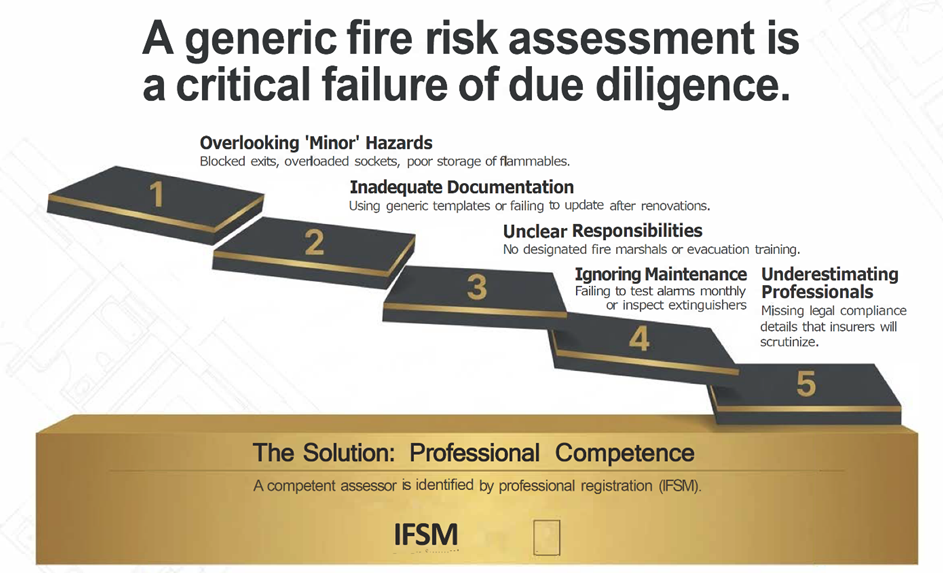
A fire risk assessment is not a "once-and-done" task. Relying on internal assessments or generic templates, especially in intermediate or complex premises, can lead to serious errors,.
Common mistakes avoided by using professional consultants include:
Underestimating Hazards: Focusing only on obvious risks while ignoring small issues that often trigger emergencies, such as overloaded extension leads, blocked fire exits, or poor storage of flammable materials.
Using Outdated or Inadequate Documentation: Relying on generic reports or failing to update the assessment after renovations, expansions, staff changes, or policy updates. Outdated documentation will not withstand inspection.
Lack of Professional Insight: Without professional input, hazards may go unnoticed, reports may miss crucial legal compliance details, and emergency plans may be incomplete. Crucially, if the assessment is inadequate, insurers may reject claims following an incident.
Working with experts who bring legal knowledge, experience in fire behavior, and a trained eye ensures the assessment is thorough, accurate, and legally defensible,. This helps identify and control potential ignition sources before an incident occurs, preserving business continuity.
If a major fire occurs, the business consequences are often catastrophic, frequently involving the loss of premises, stock, vital records, and customer trust. Insurance industry statistics indicate that around 60% to 80% of businesses may not recover after a major fire and could permanently close within 18 months. Beyond compliance and financial concerns, the consultant helps ensure the moral duty to protect staff, customers, and visitors is met, prioritizing safe evacuation and functional detection systems.
Conclusion
For small to medium businesses, competent health and safety and fire risk advice should be viewed as a proactive investment rather than a reactive expense. Specialized consultants offer the expertise to navigate complex legislation, mitigate operational risk, secure international accreditation (like ISO 9001, 14001, and 45001), and foster a robust safety culture,
By leveraging external competence, SMEs benefit from enhanced business continuity, substantial long-term cost savings by avoiding accidents and penalties, and improved employee engagement and retention,. Ultimately, choosing specialist support allows businesses to focus on their core functions while knowing their legal obligations are met and their people and assets are protected.
Comments